Brickell Condo Index – February 2009
February 20, 2009
by: Lucas Lechuga
A lot has changed since I last published the Brickell Condo Index three months ago. Condo foreclosures have continued to hit the market, financing has become extremely difficult to obtain and a few bulk condo deals have closed in that time. As a result, it should come as to no surprise that overall condo prices have continued to drop throughout Brickell within the past 3 months. The data used to compile the statistics below was collected on February 18, 2008 from the MLS. You may want to compare the following figures to those published three months ago in November 2008. Also, be sure to view the charts towards the bottom of this post to see how much Brickell condo prices have changed within the past 15 months.
The average asking prices of the 18 condo developments that comprise the Brickell Condo Index is currently $401.30 per square foot. This represents a 6.57 percent drop in average list prices over the past three months.
Average price per square foot of Brickell condos currently listed on the MLS:

The average price of Brickell condos sold over the past six months has gone up 1.51 percent to $296.00 per square foot from November’s average of $291.59. However, this is due to the fact that Four Seasons Residences had been excluded from the average in November due to no closings occurring within the previous six months. Four Seasons Residences has been reincluded in this month’s index as a result of a condo closing in December 2008. The average for Brickell condos sold over the past six months would have dropped 3.58 percent had it not been re-included. With the exception of Bristol Tower, average sales prices for each of the other Brickell condo developments dropped since the November update.
Average price per square foot of Brickell condos sold in the MLS within the past six months:
- Atlantis – 2025 Brickell Ave | 33129 | $228.95
- Brickell on the River – 31 SE 5 St | 33131 | $234.18
- Bristol Tower – 2127 Brickell Ave | 33129 | $385.20
- Emerald at Brickell – 218 SE 14 St | 33131 | $209.63
- Four Seasons Residences – 1425 Brickell Ave | 33131 | $518.62
- Imperial at Brickell – 1627 Brickell Ave | 33129 | $263.68
- Jade – 1331 Brickell Bay Dr | 33131 | $362.33
- Latitude on the River – 185 SW 7 St | 33130 | N/A
- Neo Vertika – 690 SW 1 Ct | 33130 | $221.73
- One Miami – 325 & 335 S Biscayne Blvd | 33131 | $254.09
- Santa Maria – 1643 Brickell Ave | 33129 | $756.82
- Skyline on Brickell – 2101 Brickell Ave | 33129 | $278.43
- Solaris at Brickell – 186 SE 12 Ter | 33131 | $201.59
- The Club at Brickell Bay – 1200 Brickell Bay Dr | 33131 | $188.28
- The Mark on Brickell – 1155 Brickell Bay Dr | 33131 | $228.61
- The Palace – 1541 Brickell Ave | 33129 | N/A
- Villa Regina – 1581 Brickell Ave | 33129 | $256.71
- Vue at Brickell – 1250 S Miami Ave | 33131 | $147.18
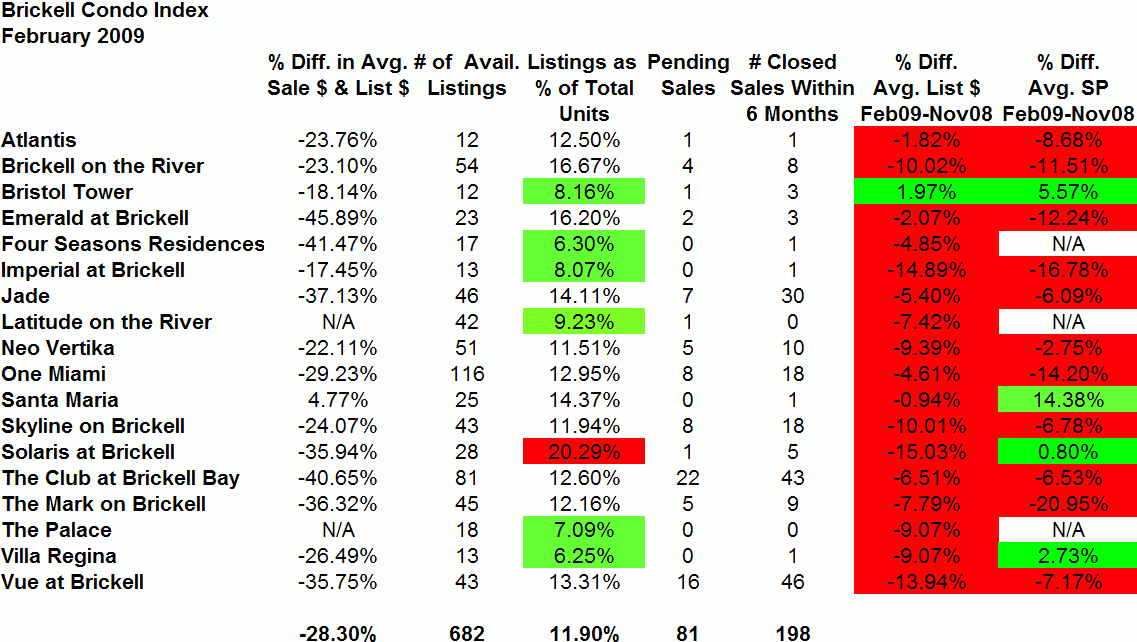
Below you will find some additional statistics. Click on the image to enlarge it.

The first column to the right of each condo development’s name is the difference in the average sales price and list price for this month, expressed as a percentage. An “N/A” is found next to Latitude on the River and The Palace since this percentage could not be computed as each building failed to have a closed sale within the past six months through the MLS. A high percentage indicates that there is a large discrepancy between the average asking price for condos currently on the market and what has actually sold within the past six months.
The second column is the number of active listings in each condo development currently in the MLS. The third column shows the percentage that these listings represent over the total number of condo units in each development. The cells highlighted in green reveal those condo developments that have active listings that represent less than 10 percent of the the overall units in the building. This is typically one indication of a sound condo building. Bristol Tower, Four Seasons Residences, Imperial at Brickell, Latitude on the River, The Palace and Villa Regina are the condo buildings highlighted in green. However, I think it’s too soon to use this rule of thumb for Latitude on the River. It’s too new of a development. Short-sales and foreclosures have just started to hit the market there. The ones highlighted in red reveal those condo developments that have active listings that represent over 20 percent of the overall units. There’s definitely underlying risk in buying in these condo developments and I’d only advise buying in one of these if the price justifies the risk. As in the November update, Solaris at Brickell is the only condo developments highlighted in red. This is usually a good indication that prices will fall further in future months.
The fourth column shows the number of condos currently pending sale. There are currently a total of 81 pending sales in the 18 condo buildings represented in the Brickell Condo Index. I did not include pending sales that went pending before November 1, 2008. The fifth column displays the number of closed condo sales within the past six months. The 18 Brickell condo developments have had a total of 198 condos close within that time frame. The vast majority of these closings occurred in just a handful of the condo developments. Latitude on the River and The Palace were the only two condo buildings that haven’t had a condo close within the past six months.
The sixth column shows the difference in the average list prices from this month’s and November’s, expressed as a percentage. Those highlighted in red reveal those condo developments which had a drop in their average list price while those highlighted in green show those that showed an increase. Bristol Tower was the only condo development that had an increase in asking prices since November. In just three month’s time, average asking prices fell about 15 percent at Imperial at Brickell and Solaris at Brickell, 14 percent at Vue at Brickell and 10 percent at Brickell on the River.
The seventh column reveals the difference in average sales prices from this month’s and November’s, expressed as a percentage. The Mark on Brickell saw the largest drop with a 20.95 percent decline. Brickell on the River, Emerald at Brickell, Imperial at Brickell and One Miami also had double digits drops. Average sales prices at Santa Maria increased about 14 percent but it should be noted that only one closed sale occurred within the past six months.

I thought it would be interesting to see how prices compare now to those we saw a year ago. Unfortunately, I didn’t publish a Brickell Condo Index 12 months ago. However, I used data from the November 2007 Brickell Condo Index to create the charts below to compare current prices to those we saw 15 months ago. Click on the images below to enlarge them.
(Below) Percentage Change in Average $/SqFt of List Prices Within 15 Months:

(Below) Percentage Change in Average $/SqFt of Sales Prices Within the Last 15 Months:

Keep in mind that condo prices in Miami peaked around the beginning of 2006. The graphs above would be all the more shocking if we were to cross compare current prices to those we saw at that time. By November 2007, Miami condo prices had already fallen significantly.
One positive thing to note is that the number of condos on the market in the condo buildings comprised in the Brickell Condo Index is down about 26 percent since November 2007. (This excludes Latitude on the River which had not been included in the Brickell Condo Index at that time.) Emerald at Brickell and Santa Maria are the only condo developments in the Brickell Condo Index that now have more condos listed than in November 2007. To put this into perspective, the number of listed condos at Vue at Brickell 15 months ago represented a little over 24 percent of the total condos in the building. Current inventory at Vue at Brickell represents slightly more than 13 percent.







lucas
since you were a finance guy…the data might be easier to read and digest if you put it in a bid ask format that you see for stocks.
bid ask
jade 300 500
it’s not exactly the same concept, i.e., you’re listing sales prices of transactions that have cleared not what someone would be willing to pay going forward but i think most recent sales for an illiquid market such as real estate are a good starting point for what the next purchaser may be willing to pay.
Jade seems to have a huge number of sales (30) for an established building. Wonder how many were foreclosures.
richard, most of them. It doesn’t matter what the closing rate is. As soon as a few sales at drastically reduced prices occur, all the speculators holding properties in the building see they’re underwater and default. Federal Reserve Bank studies have shown this to be the #1 factor leading to foreclosure.
Excellent info Lucas, 3.5% drop in six months is good for the market, but wait until the newer buildings start pressuring the prices more.
The percentage change graph is the most important piece of info here.
I am impressed by Santa Maria, but I’ve always believe that building is in a league of its own.
Lucas you are promoting misinformation: how does amalgamating all the sales into a single number give you ANY info? Maybe falling prices caused people to buy more expensive homes than they would have bought. You can only compare within the same building. Prices have fallen way more than 3.5%!!!
I feel like it’s time get my feet wet. At this rate I could be priced out of the market for years. I’m not going to see deals like this for awhile. With all the foreign investors here, the market in Miami is different. That’s because all real estate is local. And they’re not making any more land. Why throw my money away renting? It’s time to get in the game. You can’t win if you don’t play. I can do this!
“they don’t make more land”
Real estate prices in Tokyo declined for 20 years. 20 years. Let it sink in. 20 years.
“renting is throwing money away”
If it costs you (say) $2,000 a month to rent vs $4,000 a month to own the same property, who do you think is throwing money away.
“priced out forever”
Dude, have you seen the number of empty apartments in buildings? Forget the coming wave of foreclosures. Today’s existing supply is so great you can sit back and let the prices come to you.
“foreign investors”
They’ve lost money like everyone else. They are out there, but not in quantities some on this blog would have you believe. Miami real estate is not the only market that was wildly inflated and is taking a drubbing. All of these RE opportunities (term is used loosely) are competing for the same investment dollars
Sit back, be patient. There’s a lot more bloodletting still to come
2pence, we need a font for sarcasm.
Hugo P,
The 6-month average actually dropped 3.5% change over the past 3 months (since the November 2008 update), not six months. Reading it again it does sound a bit confusing. The important numbers are the percentage declines amongst the individual condo buildings.
BMW M3,
Did you even read the entire post? I did show how prices have changed within the same building within the past 3 months. For example, I showed that average sales prices at The Mark on Brickell went down about 21% since then.
All valid points, however Mr. M.A. Lott says that there appears to be some backing in this young (baby) market.
http://www.youtube.com/watch?v=ru_fcdcmY6g&feature=related
i hate rumor mongering but i keep on hearing it (and the review’s article today raises the issue as well )…related has some major storm clouds coming its way.
Miami’s Einstein:
http://www.miamiherald.com/news/breaking-news/story/912932.html
jcrimes said: “related has some major storm clouds coming its way”
Thanks for opening the door so I won’t be accused of bashing the sacred cow again:
February 20, 2009
Daily Business Review Last updated: February 20, 2009 11:03am
Related Seeks Hotel Investor
By Paola Iuspa-Abbott
The Related Group, whose new Icon Brickell is saddled with a hefty debt load, is looking for an investor or buyer for the project’s hotel component. Jorge Perez, chairman of the Related Group, recently recruited Holliday Fenoglio Fowler in Coral Gables to find a buyer or an investor for the Viceroy Hotel, Resorts & Residences at Icon Brickell in Miami’s financial district. The hotel opened last week at 501 Brickell Ave.
If a deal goes through, the cash could help Perez pay down Icon Brickell’s $176.5 million construction loan from LaSalle Bank. The loan is set to mature in November, according to Miami-Dade County property records. Executives of the Related Group did not return calls for comment. Representatives of Holliday Fenoglio confirmed they were marketing the property but declined further comment.
The 150-room luxury hotel is part of the 50-story building in Perez’s Icon Brickell development. Although the hotel is part of a high-profile project, it’s a bad time to be seeking a buyer, several real estate experts explain. “There is no financing available for hotels, and occupancy and room rates are going down,” says real estate broker Abraham Wien. “The only reason someone would put a hotel on the market at this time is because they are in financial trouble.”
Related recently completed the three-tower Icon Brickell, which has a total of 1,700 units. Closings at Tower I began in December, and so far only 17 condo sales have been recorded with Miami-Dade County. Contract holders of more than 120 units are suing Related in an effort to get out of their purchase agreements.
Related built six condo projects in Downtown Miami and the Brickell Area during the 2002-2007 housing boom. Icon Brickell is the last project to come on line. The market value of a hotel, as with most income-producing properties, is largely based on its revenue history. Determining the value of the newly opened hotel will be difficult.
“Selling a hotel in today’s market without even having a track record, means they are going to have to accept a price that is probably not much more than their construction cost,” says Mel Roth, president of International Mortgage & Equity Advisors of Florida in Parkland. “Without a track record, you have an asset that no one knows what it is worth. You are not going to be able to sell it at a premium under any circumstances. It is absolutely impossible.” That means Perez may have to sell at a discount. Wien, who often represents European and Latin American funds, indicates his clients are only interested in cut-rate properties.
Hotel buyers that need financing are likely to come up empty-handed, Roth adds. “It is more difficult to get a permanent loan on a brand-new hotel than it would be getting a construction loan to build a hotel,” he says. Lenders will finance about 65% of the value a hotel if the operator can prove its net operating income generates at least 140% of the debt coverage, he explains.
Roth knows how hard it is to land financing since the financial market began to implode in late 2007. After more than a year of negotiations, he helped secure a $250 million loan in October to complete construction of Met 2 Financial Center in Downtown Miami. Met 2 will be an office tower that will include a hotel under the JW Marriott Marquis Hotel Beaux Arts name. Roth had initially negotiated the loan with Bank of America and Wachovia, but as the credit market deteriorated, the banks had to join forces with HSBC Bank, RBC and Bank of Scotland to come up with the $250 million loan.
In relation to the hotel market, the recession is taking a toll on tourism, one of Florida’s main economic engines. Owners are seeing room rates slide and occupancy levels drop. Miami’s Downtown and Brickell areas saw the hotel occupancy rate fall to 60.8 % in December 2008 from 64% in December 2007, a drop of 5.1%, according to the Greater Miami Convention & Visitors Bureau. Countywide, the hotel occupancy level declined by 8.5%. Daily room rates in Downtown and Brickell slipped to $168.30 from $189.90, a drop of 11.4%. Countywide, room rates declined 6.6%.
“We are now at a point where we have peaked in terms of rates and occupancy,” says Guy Trusty, a hospitality consultant in Coral Gables. He explains that the hotel industry began a downward trend in early 2008, after almost seven years of growth.
Hotel values across the nation are expected to plummet by up to 30% in 2009, reveals Scott Smith, vice president of the Atlanta office of PKF Consulting, a hospitality and real estate advisory firm. In an indication of falling values, declining revenues are increasing capitalization rates, a measure of cash flow that determines a property’s market value. In the last year, cap rates of luxury hotels have increased one to two basis points, to more than 8.5%, lowering the market value of properties, says Wien, with Holly Sime Real Estate in Coral Gables. “It means your money goes further as a buyer,” adds Trusty.
Kor Hotel Group, which also operates the Tides in Miami Beach, is introducing the Viceroy brand to South Florida through Icon Brickell. Hotel rates at Viceroy Miami start at $500 a night. The fact the hotel flag doesn’t have much name recognition in the region won’t help boost the sale price or improve the chances for financing, Roth comments. Kor did not return a call for comment before deadline.
In the last six months, Related has refinanced and sold at big discounts condos it couldn’t sell at two of its new high rises in Miami-Dade. In December, Related’s TRG-Harbour House affiliate sold 101 units for $27 million in Bal Harbour’s New Harbour House, a condo conversion project. Related sold the units at prices as much as 60% below the cost of units sold to individual buyers in the last two years.
In July, Related sold 146 condos for $36.4 million in the 50 Biscayne condominium tower in Downtown Miami. The bulk buyer at 50 Biscayne was a company owned by Related and an equity partner, Lubert-Adler Partners of Philadelphia. Related and Lubert-Adler bought out Atlanta-based Cousins Properties, which built 50 Biscayne in partnership with Related. The price per unit in the 50 Biscayne bulk purchase averaged $247,739 at a time when individual condos on Biscayne Boulevard were selling for an average of about $309,936. A few months later, Related and Lubert-Adler financed some of the condos acquired in the bulk deal with a $20.87 million loan from Prudential Insurance Company of America.
If Related doesn’t find a buyer or investor for the Viceroy, the company may have to negotiate with LaSalle Bank for a loan extension. “The natural thing to do in today’s market is you go back to the construction lender, who has to recognize that there is no financing available for a hotel with no track record,” says Roth.
Paola Iuspa-Abbott can be reached at [email protected]
******************************
Time for Big Gourge to jump on the Obamunism Bailout Wagon!!
moretroops…I strongly agree with 2pence….prices will fall a lot further this year and next. Numbers for renting vs owning aside…ask yourself this if you are considering buying right now…”What is my potential reward and what is my potential regret ?” if you buy today you may feel rewarded for jumping in and getting a “good” deal…but if the unit you buy today is worth $50K less (or more) in 1 year…what will be your regret ? If your potential regret (only you know this) exceeds the feeling of reward today, then I would not do it. I always look at every financial situation this way…in other words can you live with the loss if the worst happens ?
Also, if everything else was “normal” in the global economic landscape and this was just a Miami bubble bursting then yeah you could say we could have a 5 year price recovery…but based on global fundamentals …..it could be another Tokyo situation.
My 2 cents
Even the Dumb Money can no longer argue the facts for numbers don’t lie.
The Smart Money.
Recovery 5 years, 2 years, 10 years. What recovery could you possibly be talking about.
Let’s see. Let me put on my thinking cap. How long do I think it will take for Miami, Brickell and area condominium prices to recover to an insane price based on sheer fraud, no income requirements, no concept of someone actually ever using the condo, no or little down payment, no relationship whatsoever to home value, utility, rental or investment value no relationship to anything other than an investment pyramid.
I think things look pretty bad and it may take longer than 3rd quarter 2009, but by 1st quarter 2010 we should all be back in business. Where is that font key.
RCR
Well done.
RCR…I agree with you…there will be no recovery back to these prices.
Lucas,
2 questions; why isnt avenue on brickell and the plaza included? and why is one miami there? One miami is in downtown Miami.
I completely disagree with the statement that prices will never come back. They will come back. It will take some time though unless it is going to be chaos of world proportions. If that happens then who cares about prices.
Raffi,
Avenue at Brickell and Plaza on Brickell are too new. I’ll likely wait until I see more resales in each before I include them. Plaza will probably be added before Avenue though. Maybe in my next Brickell Condo Index update.
I realize that One Miami is located Downtown. However, I grouped it with Brickell because there aren’t enough established buildings in Downtown to warrant a separate index for that neighborhood. In a year or so I’ll likely start to provide statistics for the Downtown buildings as well. The new Stats &Trends enhancement that my website developer is still working on will generate the information for the site automatically. It’s about 90% done and I’m hoping that it’ll be on the site within the next 2 weeks.
Awesome work, Lucas. Must have taken a lot of time to get that together. I wonder how many appraisers will steal your compilations. Who else tracks this market this closely – and currently? Can’t you trademark or copyright or somehow legally protect your “Index” in order to prevent its commercial use for free?
lara, in real dollar terms prices are not coming back at least in the next 20 years. By then, according to the inventor of the Internet, this area will be underwater anyway giving a new meaning to ocean front properties. Ahhhhh Venice.
some thoughts on when and why a price rebound should/not occur. cities like new york, boston, san francisco, and DC have very high cost of living, even higher than miami. these cities have had high cost of living for quite some time-longer than the elevated prices which existed in miami over the past few years. but miami is different than those cities. they all have had a strong existing demand for high income workers (financials, government, medical, business executives, etc). miami did not have this demand-the boom was driven by investors and rich out of towners looking for a nice vacation home in a resort destination.
after the economic collapse occurring throughout the world, prices will stabilize based on relative demand of housing in a city. new york, boston and DC will not lose the job base that drove up the price (although new york will likely shrink its financial sector), so eventually those cities will stabilize and slowly rebound in price (not sure to what level).
miami is caught in a tougher position. the demand for its new housing stock was not from a well to do working class, but of wealthy out of towners whose wealth has been hit incredibly hard in the past year. this produces a much riskier scenario for price stabilization and rebound. i just dont see the demand high enough in the near term to stabilize prices at a high level. demand will exit for household incomes under $100k, but the demand from households over $100k will be small. prices will have to stabilize according to the proper demand demographic. i dont think we have yet reached the status of the mega cities like new york and boston.
Gables
add to that the fact that those out of town wealthy folks now have a slew of locations/cities to invest in an additional home that are nicer or perhaps more convenient for them than miami.
Un-related
the unsubstantiated rumors i’m hearing go beyond the hotel. i’ll leave it at that.
but…looking at the hotel, if fenoglio sells that…they should get a massive bonus (i’ve worked with some folks there before – good choice to market this). this is a case study in business plan idiocy…you have a jw, conrad, sheraton, intercontinental and four seasons already established in brickell/downtown and occupancy is already down for these hotels. you have the epic hotel just completed with the marquis and the met 2 hotels in the pipeline. who in their right mind is going to pay anything above cost for this when (1) it’s not an established flag, (2) corp travel/lodging is being cut back significantly and (3) brickell is not a vacation spot? if this does sell in the next nine months (someone with significant capital, risk appetite and for lack of a better description, balls) it will undoubtedly be at a massive discount.
Gables, you are completely right, Lucas has done a magnificent job of packaging market data that helps a lot into understanding the actual RE scenario. But at the end of the day, the socioeconomic topics you just mentioned are the ones that really shape the ups and downs of this RE market, for the last 35 years I have seen as this socioeconomic fads, (most of them external to Miami or like you said influenced by out of towners) have shaped the prices of Miami RE.
Lucas keep up the good work and Thanks!
jcrimes said: “Un-related
“the unsubstantiated rumors i’m hearing go beyond the hotel. i’ll leave it at that.”
I know exactly where you would be going if you went on…….
My “Stalingrad I, II, and III” for Icon may be prophetic…although anyone should be able to see the obvious.
When Big Gourge said, in closing a 2005 Herald interview: :” If I am wrong, they may find me under a bridge.” THAT BRIDGE may be at 4th and Brickell…….
jcrimes also said:
“but…looking at the hotel, if fenoglio sells that…they should get a massive bonus (i’ve worked with some folks there before – good choice to market this). this is a case study in business plan idiocy…you have a jw, conrad, sheraton, intercontinental and four seasons already established in brickell/downtown and occupancy is already down for these hotels. you have the epic hotel just completed with the marquis and the met 2 hotels in the pipeline. who in their right mind is going to pay anything above cost for this when (1) it’s not an established flag, (2) corp travel/lodging is being cut back significantly and (3) brickell is not a vacation spot? if this does sell in the next nine months (someone with significant capital, risk appetite and for lack of a better description, balls) it will undoubtedly be at a massive discount.”
If you want to spend $500 a night for a hotel room (assuming the Super Bowl is not in town), you can afford the extra $50 for a Town Car ride to South Beach. That said, SoBe hotel rates are going to be dropping as well.
The large private equity firms who are still “playing” in this market would rather take on a needs-to-be-renovated business hotel in LA or NY. It’s the two to five year historic numbers that will attract a profit-motivated buyer in this market. “No solid STR Report, no financing. The recent days of 4 to 5 Cap Hampton Inns is OVER…….
forbes miami 9 th worst city……..if you are from the north east looking for miami condos, your not looking in this area!!! you want the beach aventura etc,
the recession/depression is not even 50% finished, so if you ar buying now-you are buying a falling knife!!!there is no easy credit anymore, the average person does not understand this fact!!!!!!if you still have credit cards and a job, you are ahead of the game, forget about buying condos!!!!
take out the scammers, the flippers, the ny ers are not moving to florida anymore/,
no more easy credit, new rules and regs………..its going back to simple supply and demand!!! and there will be much more supply so that =lower prices!!!!!3 years=ANOTHER 50 % DISCOUNT GUYS……….UNLESS S.AMERICA CAN SAVE THE DAY I AM PATIENT
LARA, IT IS DISASTER OF WORLD “PROPORTIONS ” ? DO YOU FOLLOW THE NEWS ??
LOOK AT THE STOCK MARKET WHICH TRADES 6 MONTHS IN ADVANCE USUALY IT IT JUST BROKE THE NOV 20 TH LOWS NOW WE ARE CLOSE TO 2002 LOWS…….
IF GEITNER DOES NOT HAVE GOOD INFO THIS WEEK, S AND P HEADED TO 620
THIS IS A DISASTER
I JUST WISH I DID NOT PAY MY BILLS SO OBAMA COULD SAVE ME
drew299 said: “I JUST WISH I DID NOT PAY MY BILLS SO OBAMA COULD SAVE ME”
OBAMUNISM overlooks one fact in saying “fewer foreclosures = higher, stable prices”. What it overlooks is the fact the just because you put a higher price on something, it value doesn’t necessarily increase.
OBAMUNISM will hit a wall…like ole Dale Earnhardt did!
rant of the year!!!! I AM SURE Y’ALL SAW IT ALREADY BUT IN CASE YOU DIDN’T
http://www.youtube.com/watch?v=bEZB4taSEoA
buy gold aem
we are the new europe
Stocks (Dow) are down to 1997 levels. Why should real estate be any different? Factor in massive Miami oversupply, rising unemployment, unaffordability of Miami condos, and I see no reason for condo prices to rise in the near term future.
Peak prices were a fantasy. They are never coming back in real terms. Get over it.
“peak prices were a fantasy” yes but i think even 40 %off peak is also a fantasy
ya gotta know when to hold em and know when to fold em
Lara is obviously in denial/delusional. She’s in up to her eyeballs in mortgages. She also doesn’t understand what’s going on (and the big big surprise that’s coming) because she keeps harping about “deals”. Honey, it isn’t a deal unless you’re getting it for 25% of what it cost to build.
I’m starting a granite countertop business. Please contact me if you want to get in on the ground floor. Serious investors only. Suzanne said we can do this.
Samson & Bori,
Thank you! Yes, it does take a long time to compile the data included in this post. Good thing I enjoy working with numbers.
BMW M3,
I can be wrong in a lot of things and I might be delusional. Yes, I do have mortgages but I do make money with today’s deals. Not a lot of money but all the time in the current market. Do you? All my negative cashflows in some properties are covered with positive cashflows in others. So I can handle my mortgages.
You cannot be always negative. the current situation is a complicated one but if you are an investor you should try to find your way to deal with it
Lucas:
You are very welcome. Keep up the great work and this great blog.
BTW, I was given a tour of Icon Brickell last week. I thought I’d hate it and almost didn’t go. Instead, I thought it was fabulous. Provided the building enforces a dress code in the common areas (white/black only, no sweatshirts, baseball caps, etc.) and keeps the place up to snuff, I’d live there in a heartbeat. Best building of them all. And what a credit to Miami. No other city anywhere in the world has anything close. If it were located on the beach, it would close out even faster than Apogee at $500/sf….even with 1800 units. I was blown away.
Samson
i toured the place a few months back. you point out the major problem with the place, it’s not on the beach, thus, the prices need to be adjusted accordingly. second, the common areas are impeccable, but, my take is that’s irrelevant. it’s the units that matter, and frankly, they are not that impressive when you consider you can get the same product in other buildings in brickell at a significant discount. i agree, if the men’s locker room, suana and steam room was my own personal bathroom, yeah, then icon brickell would be the best building in miami. third, thinking about the common areas and keeping them up to snuff…i can’t help but think the mnt fee in there is going to skyrocket fast. i know, this building is targeted toward a different type of purchaser (one, who i might add, has also taken a beating with his/her discretionary income) but still, for poor and rich alike, HOA is a consideration in the equation (the question is how much).
my advice to anyone considering IB would be rent there for a year or two before buying in the building. see how the building plays out before plunking down some serious scratch on a “lifestyle” building. you might find out it’s not your lifestyle .
finally, good luck on the dress code.
I’ve been to two functions at Icon Brickell now. The project is stunning. Truly. A testament to the credit bubble.
The units themselves, however, are merely so-so. I found the kitchens small, and the bedrooms undersized. The views are great if you’re facing east or you happen to be on a high floor. Otherwise they’re not so good — a huge number face … other units. And of course the HOA fees will be brutal.
I have been told that, from an accounting perspective, the project is bankrupt. I’ve also heard that a throng of bankers convened on Miami couple of weeks ago to discuss next steps. Don’t know what happened.
Not good.
Miami Rental Market.
Does anyone have any suggestions on the submnarkets and buildings that will prove to be the most popular condo’s for rentals? Preferably something very walk-able near retail, and quality but not over-the-top HOA’s.
Thanks
Tex
tex, if your looking to rent why do you care about HOA’s? you wont be paying them.
moretroops, in his back-handed compliment to Icon, said: “I have been told that, from an accounting perspective, the project is bankrupt. I’ve also heard that a throng of bankers convened on Miami couple of weeks ago to discuss next steps. Don’t know what happened.”
Big Gorge being wheeled to the edge of the abyss. The “fat lady” is warming up in the background!
Once again: “STALINGRAD I, II, and III”
Big Gorge will be fine. I can’t imagine his personal exposure will be anything that leaves him with less than a major fortune.
Apart from the model’s mouth, a pretty lifeless ad for the Viceroy at the Icon Brickell appears on page 109 of today’s NY Times Styles Magazine.
Anybody know what the total debt on the Icon Brickell is?
Depending on the amount, if I were the developer I’d run the numbers as a co-op, i.e., sell the units for a small amount of cash each but subject to their pro rata share of the existing debt (extended, say, for 5 years, at which time each buyer would have to (but perhaps could) obtain refinancing thereby converting the building back to condo status.
This approach also answers the problem of today’s lack of condo acquisition funding. By having each purchaser assume a share of the existing debt, you have in effect given them acquisition financing. In essence, the construction financing is converted to 1,700 individual co-op loans.
Of course, the question is how much existing debt we’re talking about….
The problem with Icon Brickell is that its located in……Brickell. All those pretty Ocean Drive magazine ads made Brickell seem like the bustling Las Vegas strip or Rodeo Drive. Its not a vacation mecca and never will be. Miami is not NYC, and anyone making decent money is going to want to live on the beach.
And like someone else said, half of the views completely suck.
samson said:
“This approach also answers the problem of today’s lack of condo acquisition funding. By having each purchaser assume a share of the existing debt, you have in effect given them acquisition financing. In essence, the construction financing is converted to 1,700 individual co-op loans.
Of course, the question is how much existing debt we’re talking about….”
Let’s see…..you suggest the lenders restructure one or two loans into 1,700 loans on units sold at the very height of the market. Unfortunately, you overlooked a few realities dreaming up this scenario:
1. How many of the 1,700 purchasers would be able to close in today’s economy…even if they had financing? Big Gorge offers to “finance anybody”! They still have only closed 1.0% of the Stalingrad Project.
2. Big Gorge sold these units under Florida Condominium Law. Re-jiggering the Stalingrad into co-ops would require, FIRST, undoing all of the sales made under condo law. I would bet that 90% (or 99%) would grab their 20% deposits back and RUN for the hills.
3. You had some “upstanding” lenders financing Stalingrad, including Lehman Brothers (app. $75,000,000), who really aren’t in a position to re-jigger their “former” loan portfolios to allow this idea of yours to progress.
Nice try…….
Un-Related:
As to your point #1, there are – to the contrary – certainly 1,700 prospective purchasers out there with decent credit who could of course close if they were offered, say, 95% financing via the conversion of the project to a co-op.
As to your point #2, what you assume might happen (all those in contract taking their money back and “running for the hills”) would be a far better scenario for the developer if the co-op approach worked especially given the avoidance of the protracted litigation now looming by those currently in contract.
As to your point #3, I fail to see why the existing lenders would not consider converting to a co-op as there seems to be nothing but trouble ahead in plodding down the condo route. Were I Lehman Brothers’ trustee in bankruptcy I would certainly prefer to have 1,700 credit-worthy borrowers on the hook for my $75M than one entity with probably no or little equity in the project at present.
Again, it all comes down to how much debt there is. Do you know?
Raffi. The reason that I care about HOA fee’s is that I want to buy a condo and rent it periodically while I travel, and I want to buy one in a popular area that can easily rent and that doesn’t have high HOA’s.
Any pointers would be much appreciated.
samson said: “As to your point #3, I fail to see why the existing lenders would not consider converting to a co-op as there seems to be nothing but trouble ahead in plodding down the condo route. Were I Lehman Brothers’ trustee in bankruptcy I would certainly prefer to have 1,700 credit-worthy borrowers on the hook for my $75M than one entity with probably no or little equity in the project at present.”
I will by the big “if”, if you answer one question. How many of the 2005 “flippers”, foreigners, and even “I wanna live theres” have the room temperature IQs not to cut their losses to 75% under the cond arrangement or grab 100% of their deposits if it were co-oped at this stange?
snmson then asked: “Again, it all comes down to how much debt there is. Do you know?”
A “really” educated “guess” is $400,000,000 to $500,000,000
Un-related:
Assuming, as you say, $500,000,000 is the total indebtedness on the entire three tower project including the Viceroy hotel component, then if each of the 1,700 condos were sold via the co-op route (each unit assuming its share of the total debt), the average condo could be sold for as little as $294,117.64 ($500M/1,700) to pay off the debt (before developer’s closing costs and legal fees) with the hotel component as profit to the developer.
Assuming the average condo is 1,000 sq. ft., that’s roughly $300 per sq. ft. The buyers don’t have to put down a penny in cash; they only have to assume – on average – $300,000 of the developer’s debt (restructured to have at least a 5 year term and market rate interest).
And the developer gets to keep the Viceroy Hotel as profit.
Why wouldn’t that work?
samson
lame answer…but, it won’t work b/c if it did, they would have already done it. don’t be surprised if the note is sold in bankruptcy to a distressed fund operated by a reit. they’ll try to knock out related and take over the project.
moretroops
that’s the rumor passed on to me from a mid level person at related. the only thing i would add is that i was told the bankers weren’t just talking about icon. again, i emphasize, this is all just rumor, albeit from a decent source.
rcr
this isn’t rumor…you’re 100% correct.
Jcrimes:
You can do better than that: (My idea) “won’t work because if it did they would have done it already”.
I think you presume too much. So far, no one can show me why my idea won’t work. Period.
People – developers – have tunnel vision. If you started it as a condo, you have to finish it as a condo, even if by so doing it finishes you. Tough times like these force you to rethink everything. You have to go outside the “condo” box to solve this one. When you think about it, all I’m really suggesting is a novel twist on “securitization”. Take the big debt, divide it into 1,700 pieces and sell them off to third parties, in this case would be condo buyers who can’t get condo acquisition loans.
samson
just don’t know much about co-ops…although i do know they are very exclusive and require significant financial resources to be a member of. i don’t think (and this is entirely conjecture) the typical co-op takes f0lks who finance 80% or more of the purchase price. considering you’re all in it together, i’d imagine the typical co-op board wants to see a significant equity commitment on the part of any new member. moreover, i’m not sure there’s ever been a 1700 unit co-op before. factor in the above requirements and i’m not sure how it could work for a project of IB’s magnitude. outside of having everyone being forced to to make a significant financial commitment to a building, would you ever trust your neighbors to follow through? if not, you’re on the hook big time.
Samson, what a brilliant suggestion. Many public housing developments have been sold to residents through cooperative ownership. It strikes me as a win/win situation.
Jcrimes, some coops are exclusive (740 Park Ave, 834 Fifth Ave, etc etc) but the form of ownership doesn’t have to be.
Jcrimes:
I think you are thinking about NYC, where co-ops litter the noble Park and Fifth Avenues. There is nothing particular exclusive about co-ops nor need their rules require their members to have significant financial resources. In fact, their rules can be silent on the issue.
The difference between condos and co-ops is simply this: the owner of a condo owns his/her airspace and percentage of the common areas and ground free and clear (in fee simple aboslute), subject only to such mortgage as he/she wishes/or needs to encumber it with. The owner of a co-op, on the other hand, does not own real estate in fee simple; he/she owns shares of stock in the entity which owns the property (subject in most cases to pre-existing debt on the property) and enjoys exclusive possession of his/her unit by virtue of a 99 year proprietary lease thereto. A co-op owner can only pledge his stock in the ownership entity as collateral for a loan – but not the unit itself as he does not technically own it. As a practical matter, you “own” your apartment in either format.
There are thousands and thousands of co-ops in New York and many are not “exclusive” at all. A co-op board may – but may not – require anything by way of financial resources on the part of its members. There is nothing inherent in co-operative ownership which connotes exclusivity or which places any higher financial requirements on its members than condos.
Let’s say Icon at Brickell became a co-op, as I theorized. Let’s say you wanted to buy one that cost $310,000. Instead of writing a check for $310,000 or borrowing a percentage of that price (which would be the case if it were a condo), you would instead buy X shares of Icon at Brickell co-op association for, say, $10,000 cash but subject to its pro rata share of the co-op’s underlying debt, say, $300,000 of the total debt. You will have in effect paid the same $310,000 price as you would have were it a condo, the difference being that you only had to lay out $10,000 cash and did not have to get a mortgage loan for the balance as the developer/seller in effect provided you with the $300,000 in acquisition financing.
Let’s say the unit you wanted to “buy” was 1,000 sq. ft. If the building was a “condo” rather than a “co-op”, your monthly common charges (HOA) would be, say, $800 a month. But if were a co-op, you’d pay this $800 plus your pro rata share of the debt service on the $500M mortgage on the building plus your pro rata share of the real estate taxes on the property.
We have assumed that your share of the total mortgage was $300,000 ($500M/1,700 units). Therefore, assuming the mortgage debt were 6% with no amortization, you would owe an additional $1,500 per month ($300K x 6%/12). You would also be obligated to pay your pro rata share of the real estate taxes on the entire building. As I have no idea what the taxes on the property are, I’ll just guess and say your 1/1700th share comes to $500 per month (is it conceivable that annual real estate taxes on the property are $10.2M, as I have just assumed?).
Bottom line is that as a co-op owner of Icon at Brickell, your monthly maintenance charge would be $800 (HOA same as a condo) plus $1,500 (your share of the interest on the property’s $500M mortgage) plus $500 (your assumed share of the real estate taxes on the property) for a total of $2,800. If is were instead a condo, it would cost you the same per month provided, of course, that you could find a bank to lend you $300,000 of the total $310,000 purchase price and at 6% interest only – which we all know is virtually impossible.
The point of the exercise is really to demonstrate an exit strategy for the developer. Why set it up as a condo when no one can get condo acquisition financing in Obamanation?
Lenders, including the now bankrupt Lehman Brothers, have already provided the financing required by 1,700 prospective unit buyers. It’s just a matter of fairly allocating (“splitting”) the total debt amongst the 1,700 units ($300K each on average), converting the property to a co-op and selling shares in the co-operative association which owns the building subject to the $500M in debt for, say, $10,000 cash on average for the shares allocated to the average unit.
If Icon at Brickell
Bobby J:
Thank you. And just think – as a co-op where you simply paid for your unit by assuming a portion of the building’s pre-existing debt, you could tell your friends back home that you owned your unit at Icon at Brickell “free and clear” which would be technically correct as your evidence of ownership, your shares of stock in the association which owned the building, would be “free and clear”. You could sell your unit (the shares) to anyone you wanted for whatever price you wanted and not have to pay off anyone in the process. Say you found a buyer for $100,000. Keep all the cash. Whether your buyer came up with the $100,000 in cash or hocked the shares to a lender is his business.
And, in addition to pride of ownership, the new owners assume the obligation of the ongoing carrying costs.
As they do in the case of a condominium development, the only difference being that in the case of Icon at Brickell as a co-op, they didn’t have to find a bank to lend them the purchase price. They just took over a portion of the developer’s debt equal in amount to the purchase price.
No points, no appraisals, no fees, no mortgage brokers, no bullshit…just some degree of proof you can afford to pay $1,470.58 per month ($500M/1700 x 6%/12).
Some will question the viability of a monthly carrying costs of $2800. The holder of the developer’s debt could cut the rate to the buyers. It would be better than writing down the principal. Also, with unit owners managing the building, the HOA would be less than the developer’s rate of $800.
I disagree. The $2,800 monthly carrying cost including, as it does, 6% interest on a loan equal to 97% of the purchase price, would be equal to the total monthly carrying cost if it were a condo and you borrowed 97% of the purchase price ($300,000 loan on a $310,000 purchase price) – which you could never do.
But you make an excellent point regarding lower HOA fees in a co-op. It could well be the case.
Samson, re 58. Totally agree. We need to think outside the condo box.
In co-op it is actually called a proprietary lease. A previlege to live in that part of allocated space. You own the shares and not any physical assets.
You also do not “own” any parking space either. You get one alloted and you surrender it when you sell the flat. Like in Miami condos, where you can keep the flat but you can sell your parking space or storage, co-op will not ley you do that.
Just because you do not own physical assets, you end up having to ask the board approval for every issue small and large. That is the reason why co-ops got the reputation of being either difficult or exclusive. But a majority have a laissez faire attitude like mine in NYC.
Also many have a big debt and they only pay interest on it. The interest on the underlying mortgage gets divided among all the flats every month and gets added to the maintenance bill. It is tax deductible.
My co-op is a 1200 unit and has a 10 million dollar debt. My monthly share on the interest is just $350. I hope they pay down the principal one day but no one wants to do that!
samson said: “Let’s say Icon at Brickell became a co-op, as I theorized. Let’s say you wanted to buy one that cost $310,000. Instead of writing a check for $310,000 or borrowing a percentage of that price (which would be the case if it were a condo), you would instead buy X shares of Icon at Brickell co-op association for, say, $10,000 cash but subject to its pro rata share of the co-op’s underlying debt, say, $300,000 of the total debt. You will have in effect paid the same $310,000 price as you would have were it a condo, the difference being that you only had to lay out $10,000 cash and did not have to get a mortgage loan for the balance as the developer/seller in effect provided you with the $300,000 in acquisition financing.”
***************************
Their lies the problem with your “plan”. If the debt were $500,000,000 or $310,000 per unit , which, by the way INCLUDES the hotel rooms at Viceroy, you ASSUME that Related would agree to this “repricing”. Each “purchaser” would be paying $310,000 (their share of debt) + their original 20% deposit (probably an additional $100,000) and Related would accept zero.
In the end, Related may get “0” but it won’t be because they restructured into a co-op.
You also ASSUME that this new structure would keep 100% of the original buyers in the project. With 1,700 co-op units, the chances of this are ZERO and NONE. Co-ops usually have 100 or fewer units. The logistics with this thing would cause nightmares.
The Stalingrad project should never have been built. That is obvious. For years, no matter who winds up controlling it, you will see a light or two on here and there. That’s about it. It is a monument to the condo bubble and a outstanding one at that.
Un-related:
I don’t understand what you mean when you say Related “would accept zero”. Under my proposal, they would pay off their debt in its entirety and keep the Viceroy as their profit. Not a bad outcome in this market, I think you’d agree.
I never assumed, as you say, that Related would keep 100% of its original buyers in the project. I assume they would keep none of them.
Where do you get your information? For example, that “co-ops usually have 100 or few units”. That is incorrect. Co-op City in NYC has 15,000 units. Also, you say “The logistics would cause nightmares”. The “logistics” of what? No more of a nightmare than a condo.
Whatever.
samson said: “I don’t understand what you mean when you say Related “would accept zero”. Under my proposal, they would pay off their debt in its entirety and keep the Viceroy as their profit. Not a bad outcome in this market, I think you’d agree.”
No, I would STRONGLY DISAGREE. The “keep the Viceroy as thier profit” is complete nonsense. The entire project has approximately 1,700 units, which INCLUDE THE UNITS (hotel condo rooms) at the Viceroy. Go back to “square one” and re-calculate now that you have the facts.
i broached the issue of coops a couple of months back, but the idea gained little attention except for AJ’s description of how a coop actually works. glad to see the issue is getting more discussion.
in a condo, if a building were rendered useless by a hurricane, the worst case scenario for the owner is loss of equity or owing remaining mortgage on an individual unit. what happens in the case of a coop? from what i understand, your ownership share includes acceptance of debt on the structure, which apparently can amount to millions per unit? if the building is left useless, are the shareholders still on the hook for this loan? what recourse do lenders have against the shareholders? this assumes insurance is not a factor-which obviously would exist and cover many of the costs.
Gables:
Based on my experience in New York City, the shareholders of a co-op cooperation are not personally liable for the co-op’s debt anymore than they would be personally liable for the debt of any corporation (limited liability being the “buzzword”) unless they personally guaranteed their share of the co-op’s debt and I never heard of a situation like that. The lenders of the underlying debt on a co-op – in the event of a default – can commence an action to foreclose against the property, period.
[…] cities around the US, developers are suffering the consequences of their actions. And the result? Affordable housing. No Christine Quinn […]